Riding Your Own Horse In Zion: NPS Stock-Use Rules And Trails
Zion allows personal horses, mules and burros on a specific list of designated trails, with no day-trip permit, a six-animal party limit and seasonal bans tied to trail conditions. Here is what the NPS actually says, trail by trail.
Short answer
Yes, you can ride your own horse in Zion National Park. The NPS allows horses, mules and burros on designated trails with no permit for day trips, a maximum of 6 animals per party, weed-free feed required, and a ban on stock during spring thaws and wet periods. Sand Bench is open to personal stock only November 1 to March 1.
Zion National Park permits personal stock, and the National Park Service spells out exactly how. Horses, mules and burros are the only stock animals allowed; llamas, goats, dogs and camels are not. Day trips need no permit. A single party is capped at six saddle stock or pack animals, and the park closes stock use entirely during spring thaws, unusually wet periods, or any stretch when hooves would tear up the tread. The full rule set lives on the NPS horseback riding page, and this guide walks through it trail by trail.
For context on how the park's own concessioner fits into the picture, see the Canyon Trail Rides in-park guide; that operator books directly and is separate from personal stock use. And if you are still deciding whether a DIY haul or a guided ride suits your trip, the inside versus outside the park comparison covers the trade-offs in plain terms.
Can You Ride Your Own Horse In Zion National Park?
Yes. Zion allows personal horses, mules and burros on designated trails without a permit for day trips, subject to conditions. The NPS prohibits stock during spring thaws, unusually wet periods, or whenever the Superintendent judges that use would cause undue trail damage. A wilderness permit is required only for the one overnight stock camp at Hop Valley Site A, limited to a single night.
That is the short version of the park's policy, and it surprises riders who assumed a flagship national park would shut its trails to private animals entirely. Zion does not. What the park does instead is restrict stock to a published list of trails, keep animals on the tread where trails exist, and open one off-trail corridor, Lower Coalpits Wash from the trailhead to the Scoggins Wash junction. Everything else is off limits to hooves.
The rules come from two official sources. The park's horseback riding page covers which trails are open and the seasonal framework, and the wilderness regulations page carries the enforcement detail: party size, feed requirements, tethering and the water-distance rule. Both are worth reading in full before you load a trailer, because the conditions-based ban means a trail that was legal in October can be closed in March purely because the ground is soft.
One planning note that matters to haulers: the commercial side of Zion riding is separate. Canyon Trail Rides, the park's concessioner, runs its own guided string on the Virgin River and Sand Bench Trail between roughly mid-March and October 31. Personal stock and concessioner stock share the park but not the same rulebook. The concessioner's season and check-in point at the Emerald Pool trailhead lot across from Zion Lodge are described on the operator's own page, and the booking page there is the authority for those rides.
Which Trails In Zion Are Open To Stock?
The NPS lists fourteen named trails and corridors open to horse or pack animal use, concentrated on the west rim, the Kolob side and the east rim. The Sandbench Trail is open to personal stock only from November 1 to March 1, because it serves as the commercial guided-ride route the rest of the year. Off-trail riding is allowed in exactly one place: Lower Coalpits Wash, from the trailhead to the Scoggins Wash junction.
Here is the full list as the NPS publishes it:
| Trail | Notes from the NPS listing |
|---|---|
| La Verkin Creek Trail | West of Beartrap Canyon only |
| Hop Valley Trail | Includes the only overnight stock camp, Site A |
| Connector Trail | Links Hop Valley and La Verkin Creek systems |
| Northgate Peaks Trail | Kolob Terrace side |
| Wildcat Canyon Trail | Higher elevation, cooler in summer |
| West Rim Trail | North of Cabin Spring only |
| Sawmill Spring Trail | Connects toward the west rim |
| Telephone Canyon Trail | Parallel to the West Rim corridor |
| East Mesa Trail | East of the Observation Point Trail junction |
| East Rim Trail | South of Stave Spring only |
| Deer Trap Mountain Trail | East-side rim country |
| Cable Mountain Trail | East-side rim country |
| Chinle Trail | Southwest desert section of the park |
| Sandbench Trail | Personal stock only November 1 to March 1 |
| Lower Coalpits Wash | Off-trail stock permitted, trailhead to Scoggins Wash junction |
Read the boundaries carefully, because several entries are partial. The West Rim Trail is open only north of Cabin Spring, the East Rim Trail only south of Stave Spring, and La Verkin Creek only west of Beartrap Canyon. A rider who assumes the whole length of a named trail is fair game can wander past a legal boundary without noticing, and the fine print on the NPS page is the controlling text.
The Sandbench entry is the one most worth understanding. From roughly March through October that trail is the route of the park's commercial guided rides, so public stock is locked out of it. Come November 1 the arrangement flips: the concessioner's season ends, and private riders get the Sandbench until March 1. If your dream is riding your own horse on a trail inside the main canyon corridor, that four-month window is essentially your only shot, weather permitting.
East-side riders should also know the practical geography. Several of the open trails, the East Mesa, Deer Trap, Cable Mountain and East Rim sections, are reached from outside the main canyon, often through land managed by other owners. Access roads and trailhead parking that suit a horse trailer are a separate research project from the NPS rules themselves, and the park's conditions page is the place to check before any haul. Current trail conditions there govern what is actually ridable on the day.
What Are The NPS Stock-Use Rules In Zion?
Beyond the trail list, the wilderness regulations impose six operating rules: animals must stay on designated trails where trails exist, no more than 6 saddle or pack stock per party, weed-free feed required before entering the wilderness, stock must be hobbled or tethered not left loose, manure removed from trailers, and animals kept 200 feet from water except when watering or crossing.
Each of these exists for a reason that is easy to respect once you hear it. The weed-free feed rule protects the park from invasive plants arriving in hay; feed your animal certified weed-free forage for a few days before the trip and carry only that. The 200-foot buffer keeps riparian banks from being trampled, with the explicit allowance for drinking and crossing. Grazing is prohibited outright, which is why packing enough feed matters more in Zion than in national forests where loose grazing is sometimes allowed.
| Rule | What the NPS regulation says |
|---|---|
| Allowed animals | Horses, mules and burros only; llamas, goats, dogs and camels prohibited |
| Party size | Maximum 6 saddle stock or pack animals per party |
| Trail discipline | Stock must remain on designated approved trails where trails exist |
| Feed | Weed-free feed required before entering the wilderness; no grazing |
| Containment | Stock must be hobbled or tethered, never loose |
| Water | Keep 200 feet from water sources except when watering or crossing |
| Waste | Manure must be removed from trailers |
The animal list is the rule that trips up the most inquiries. Pack llamas have a following among Utah hikers, and goat packing has grown in the region, but Zion's wilderness regulations name horses, mules and burros and close the door on everything else. If your trail partner has cloven hooves or a banana-shaped neck, this park is not the venue.
None of this paperwork is heavy by backcountry standards. There is no day-use fee beyond the park entrance pass, no stock-specific permit, no checklist to file. The burden is on the rider to know the rules and to haul out what the horse hauls in. The park trusts you with the rest, and the Superintendent's discretion clause on trail damage is the enforcement backstop when conditions turn.
When Is Stock Use Prohibited In Zion?
The NPS prohibits stock during spring thaws, unusually wet periods, and any time use would cause undue trail damage at the Superintendent's discretion. The Sandbench Trail excludes personal stock from March 1 to November 1 while the concessioner operates on it. Monsoon-season flash floods from July through September can close slot canyons and river corridors, which the park announces through its conditions page.
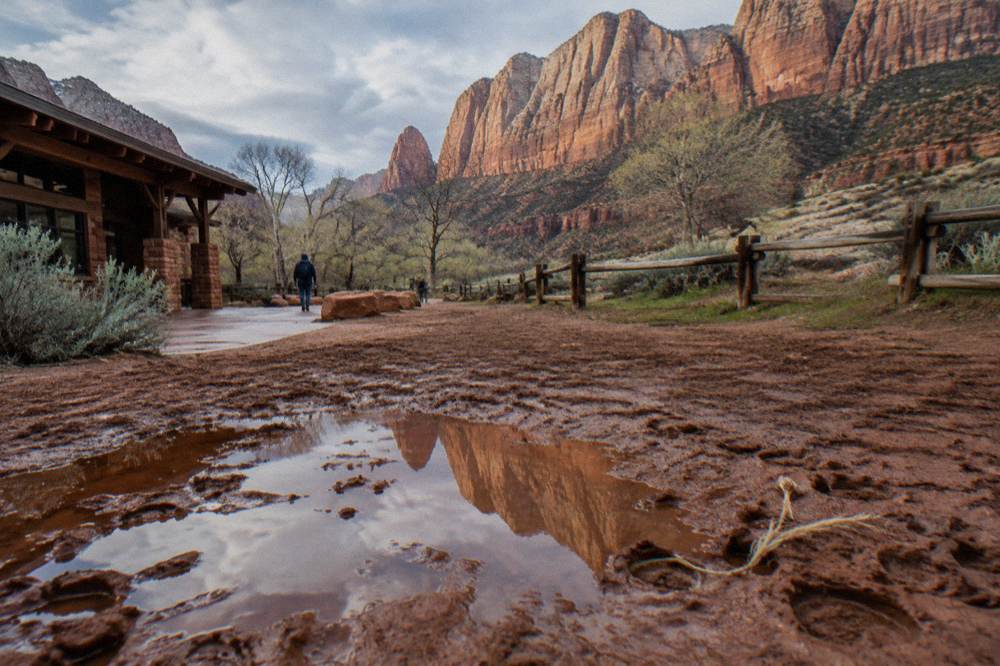
The conditions-based ban is the rule that requires the most humility from riders. Spring thaw in the Zion area typically means late winter into spring, when snowmelt saturates the clay-rich soils and a shod horse can churn a trail into a trench in a single pass. The park does not publish a fixed calendar date for the closure because the ground does not follow a calendar. The prohibition language simply says spring thaws, unusually wet periods, and times when use would cause trail damage, and the call belongs to the Superintendent.
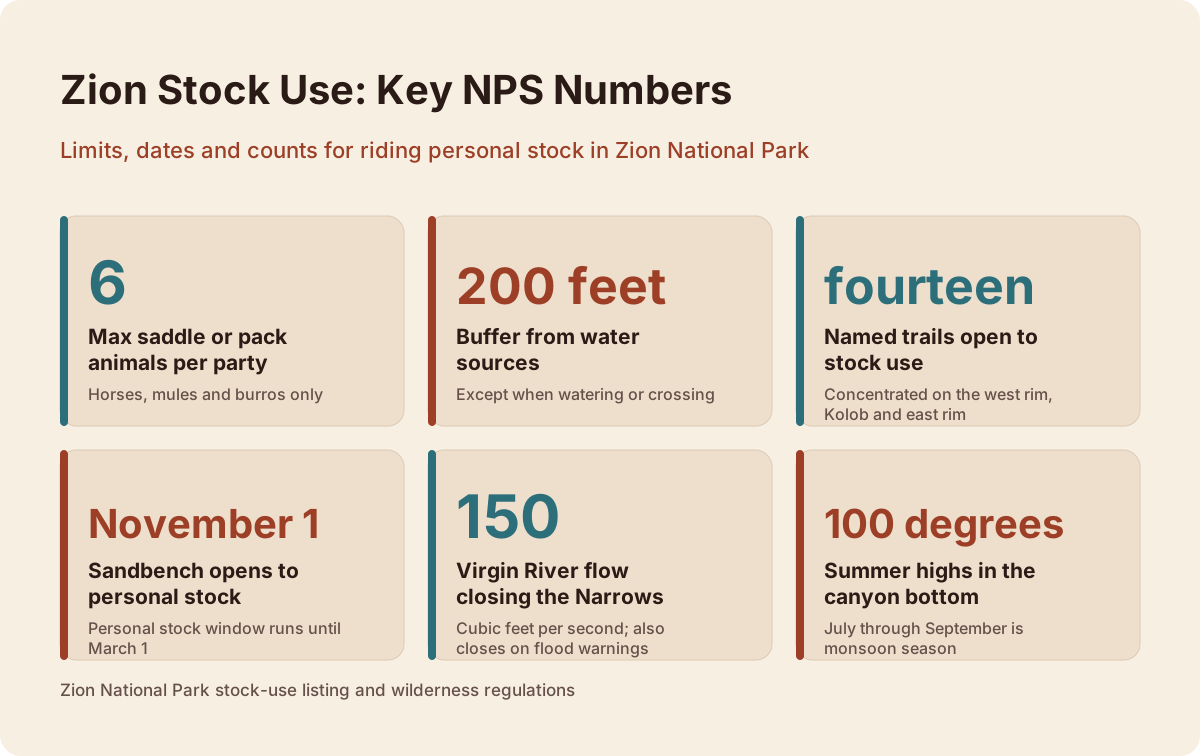
Summer brings a different hazard. The NPS seasons page notes that July through September is monsoon season with flash flood risk, and that summer temperatures regularly run over 100 degrees Fahrenheit in the canyon bottom. For stock riders the flood side matters most: the Narrows and slot canyons close when the Virgin River flow exceeds 150 cubic feet per second or a flash flood warning is issued, and those closures are announced, not predicted. Trail and canyon closures for flood risk or repairs are a standing feature of Zion logistics; the conditions page is the live source.
Planning around these windows is its own discipline. The best time for horseback riding in Zion guide maps the whole year against heat, crowds and trail access, and the pattern worth remembering is simple: spring and fall give the most reliable footing and temperatures, winter opens the Sandbench to private riders but carries thaw-closure risk, and midsummer is the least forgiving season for any horse, yours or a concessioner's.
| Period | Stock-use situation in Zion |
|---|---|
| Late winter to spring thaw | Stock prohibited when trails are saturated or damage is likely |
| March to October 31 | Guided concessioner rides run; Sandbench closed to personal stock from March 1 |
| July to September | Monsoon flash-flood risk; canyon and river closures possible with little notice |
| November 1 to March 1 | Sandbench Trail open to personal stock; freeze and thaw still govern other trails |
| Wet periods any season | Superintendent may suspend stock use to prevent trail damage |
Do You Need A Permit To Ride Your Own Horse In Zion?
No permit is required for day trips with personal stock on the open trails. The only stock-related permit in the park is a wilderness permit for overnight use of Hop Valley Site A, the sole overnight stock camp, limited to one night. Riders still need the standard park entrance pass for their vehicle, which runs $35 for a private vehicle valid 1 to 7 days.
The day-use freedom is genuine and unusual among crowded parks, but the overnight constraint is tight. One site, one night, and a wilderness permit to go with it means Zion is not a destination for multi-day pack trips the way some Utah and Wyoming backcountry areas are. Riders planning a loop with camping should look at adjacent national forest and BLM land, where stock camping is more developed, and treat Zion as a day-ride park.
The entrance pass applies even if you never leave the saddle. The NPS fees page states that anyone entering Zion, even just passing through, needs a recreational use pass, and a vehicle hauling a trailer pays the private vehicle rate like anyone else. Non-US visitors aged 16 and over pay an additional nonresident fee unless admitted on an eligible annual pass, a wrinkle in the fee rules that international haulers sometimes miss.
Paperwork aside, the practical checklist for a legal day ride is short: confirm your trail is on the open list, check the conditions page for closures and wet-period suspensions, carry weed-free feed, keep the party at six animals or fewer, and stay on the tread. That is the whole compliance burden for a day trip, and most riders who follow it report no friction with rangers at all.
Why Do Most Visitors Book A Guided Ride Instead?
Hauling a horse to Zion means trailer logistics, partial-trail boundaries, thaw closures and weed-free feed sourcing, so most riders simply book a guided ride. Outside the park, listed rides run from $68 per person for the Juniper Ridge bison preserve ride to $105 for the Kanab Cave Lakes canyon ride, with the East Zion slot-canyon ride at $75 and a 4.8 rating across 506 reviews.
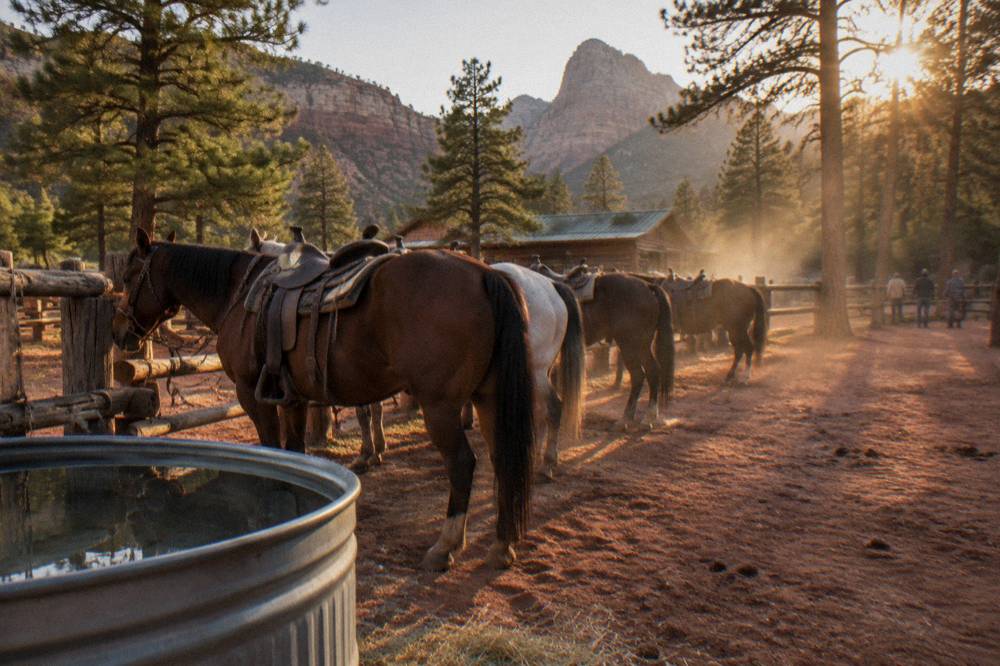
The economics explain the switch. A rider who owns a horse already eats the cost of the animal, but a Zion trip adds fuel for a tow vehicle, trailer-safe parking research, feed that meets the weed-free rule, and the risk that a thaw closure scraps the whole plan on arrival. Against that, the guided options start at $32 for the Little Wrangler kids' hand-led ride and top out at $105 for the Kanab Cave Lakes ride, horses and guide included, with no compliance homework at all.
For east-side trips specifically, the White Mountain ride from East Zion Adventures is the natural substitute for a haul. It runs about an hour from the East Zion side, is rated 4.8 across 506 reviews, costs from $75 per person, and includes a short hike into a slot canyon, something personal stock cannot do anywhere in the park regardless of rules. Riders park at the pickleball courts lot and walk to the corrals, which is simpler than any trailer maneuver in the park. Weight limit is 100 kg and minimum age 8; ask the operator about borderline cases rather than assuming.
Families with younger children land on guided rides for an even more basic reason: age floors. The Rove and Ramble rides near Mt Carmel state no minimum age or weight, and the Little Wrangler hand-led ride takes children from age 3, while a private-owner trip has no such scaffold and requires a horse that tolerates a child on unknown terrain. The age limits and kids guide lays out every cutoff in one table.
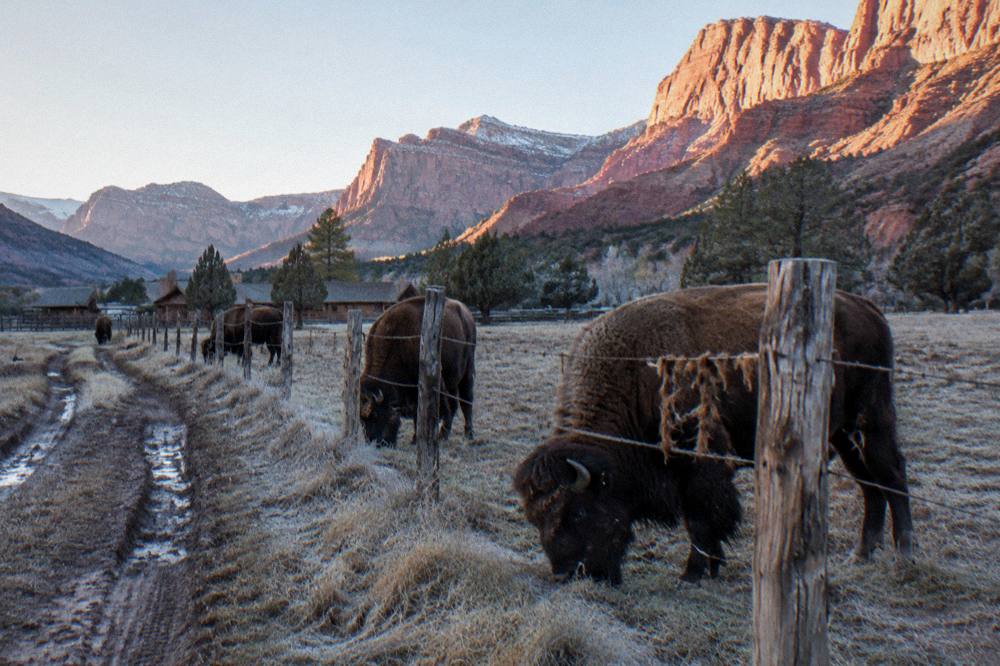
The Juniper Ridge bison preserve ride is the gentlest entry point at from $68 per person, about an hour around a bison preserve near Mt Carmel with views toward Zion, the Grand Staircase and distant Bryce Canyon, and the listing does not state a minimum age or weight limit. Sightings are a chance, never a promise. And the Kanab option, a 1.5-hour canyon ride rated 4.9 across 122 reviews from $105 per person, suits riders who want the longest guided stretch of the set; the Kanab horseback riding guide covers that corner of the region.
There is no shame in the pivot, and the two modes are not rivals. Plenty of horse owners haul to Zion in November for the Sandbench window and ride guided the rest of the year. The rules make both possible; the calendar decides which one this month favors.
For scheduling around seasons, crowds and the shuttle, the planning pieces on Zion Horseback Tours pull the whole year into one view: which entrance to use, how many days to give the park, and which ride category fits each traveller, whether the horses are yours or a wrangler's.
Common Questions About Riding Your Own Horse In Zion
What are the Zion National Park stock use rules?
The NPS allows horses, mules and burros on designated trails only, with a maximum of 6 saddle stock or pack animals per party, weed-free feed required before entering the wilderness, stock hobbled or tethered, manure removed from trailers, and animals kept 200 feet from water except when watering or crossing. Stock use is prohibited during spring thaws, unusually wet periods, or when use would cause trail damage. No permit is needed for day trips.
Do I need a permit for a day ride with my own horse in Zion?
No. The NPS states that permits are not required for day trips with personal stock. A wilderness permit is required only for the single overnight stock camp at Hop Valley Site A, which is limited to one night. You still need the standard park entrance pass for your vehicle.
Can I ride my horse on the Sand Bench Trail?
Only from November 1 to March 1. The Sandbench Trail serves as the commercial guided-ride route from roughly March through October while the park's concessioner operates, so personal stock is excluded during that stretch. The trail flips to public stock use on November 1 each year.
Are llamas or goats allowed as pack animals in Zion?
No. The wilderness regulations permit only horses, mules and burros as stock animals in Zion National Park. Llamas, goats, dogs and camels are prohibited.
Why is stock use sometimes banned in Zion?
The Superintendent can suspend stock use during spring thaws, unusually wet periods, or any time hooves would cause undue trail damage. There is no fixed calendar date; the closure follows ground conditions, and the park's conditions page is the live source.
What happens if I would rather not haul my own horse?
Guided rides outside the park start from $68 per person for the Juniper Ridge bison preserve ride, with the East Zion White Mountain slot-canyon ride from $75 and the Kanab Cave Lakes ride from $105. All include horses, guide and equipment, with no feed rules or trailer logistics to manage.