Do They Weigh You Before Horseback Riding?
How Zion-area riding operators check rider weight at check-in, what the limits are on every ride near the park, and what happens if you are over one.
Do Zion Horseback Rides Have A Weight Limit?
In most cases, no operator near Zion puts you on a scale before a trail ride. The standard practice is a verbal check at check-in, sometimes paired with a visual assessment by the wrangler, and the listed limit is enforced against whatever that check shows. Canyon Trail Rides, the in-park concessioner, publishes a 220 pound limit; some outside-park operators set their own weight caps, so check the listing for the ride you want.
The short answer is that a scale is uncommon, but the question behind the question is real, and it deserves a straight answer. Riders near a limit worry about being turned away at the corral in front of their family, after driving an hour, with a non-refundable booking in hand. That worry is common enough that it shapes how people book, and it is one of the most asked practical questions about guided rides in southern Utah.
The mechanics differ by operator, and the honest reporting is that no operator in this region publishes a weigh-in protocol in detail. What the listings and operator pages do publish is the limit itself. The in-park concessioner Canyon Trail Rides states a 220 pound limit on its operator page for both its one-hour Virgin River ride and its three-hour Sand Bench ride. The outside-park operators around Zion state their limits in kilograms: 100 kg on the East Zion Adventures rides and the Kanab Cave Lakes canyon ride.
That spread matters for trip planning more than the weighing method does. A rider who exceeds the in-park limit and the 100 kg limits at East Zion Adventures and Kanab may still have options on the Rove and Ramble rides, which include the Juniper Ridge bison preserve ride, the sunrise ride, and the Grandview sunset ride; those listings state no weight limit, so confirm with the operator before booking. Choosing the right listing up front does more for you than any check-in strategy can.
How Do Operators Check Your Weight At Check-In?
The typical check is a verbal question during check-in and a wrangler's eye, not a bathroom scale by the corral. If the wrangler doubts your answer, or the horse assigned to you is a smaller animal, the operator can ask for a confirmation and can decline to mount you. Riders should answer honestly, because a horse injured or spooked by an overloaded saddle is the outcome the rule exists to prevent.
Across the riding outfits near Zion, the pattern that riders describe in guest reviews is consistent: you arrive, sign a waiver, state anything the form asks, and a wrangler assigns you a horse. Weight enters that assignment. A stable matches rider size to animal size, and a wrangler who is unsure will ask directly. The National Park Service's own riding page does not describe a weigh-in for the concessioner's rides; it points riders to the operator, and the operator's page is where the 220 pound figure lives.
Some stables elsewhere in the country do use scales, and a few weigh every rider. Nothing in the published materials from the Zion-area operators indicates that practice here. What is published instead is the limit, phrased as a condition of riding. Treat the limit as a hard eligibility rule rather than a suggestion, and treat the check as something that can happen to anyone, not only to riders who look close to the line.
The practical advice follows from that. If your weight is anywhere near the listed limit, book the listing whose limit clears you comfortably rather than scraping under, and if you are genuinely borderline, contact the operator before booking. Operators answer these questions routinely; being turned away at the corral is the expensive alternative. The booking page is the authority on the current limit, and asking ahead costs nothing.
What Happens If You Are Over The Weight Limit?
Riders over a listed limit are typically declined at check-in and mounted on a different activity, or refused the ride, and the refund outcome depends on the operator's policy rather than on sympathy. Because the limit is published as a booking condition, arriving over it is generally treated like arriving without a ticket. This is why the honest answer at check-in matters more than any hope that the wrangler will wave you through.
No Zion-area operator publishes a detailed over-limit refund policy on the pages we reviewed. What the Canyon Trail Rides operator page does publish is a cancellation policy for its in-park rides: cancellation 24 hours in advance for a refund of the ride cost, with online booking fees non-refundable, and the booking page is the authority. An over-limit refusal at check-in is not the same as a cancellation, and a rider in that position should expect to negotiate with the operator on site rather than point at a published rule.
There are constructive fallbacks. A rider over one operator's limit may be under another's, which in this region usually means moving from a 100 kg listing to a Rove and Ramble ride, where no rider weight limit is published. Families sometimes split: one adult rides while the other drives to the viewpoint, then they swap on a later departure. The Little Wrangler kids' ride, a 15-minute hand-led loop from $32 per person, carries no stated weight limit on its listing because it is designed for small children ages 3 and up, so it is not a fallback for an adult, but it does keep younger siblings inside the experience.
| Situation at check-in | Typical outcome | What you can do |
|---|---|---|
| Weight is under the listed limit | Normal mounting and ride | Answer the check-in question accurately |
| Weight is borderline and the wrangler is unsure | Operator may ask a confirming question or assign the largest suitable horse | State your weight honestly; ask about horse assignment |
| Weight is over the listed limit | Ride is declined; refund is at operator discretion | Contact the operator before booking; consider an operator with a higher limit |
| Limit is not stated on the listing | Operator decides case by case | Ask directly before booking, as with the Little Wrangler kids' ride |
The frame to keep in mind is that the limit protects the horse first. A horse carrying more weight than it is conditioned for, over rocky sand and slickrock grades, is a lameness and fall risk, and wranglers see the outcome of overload in ways guests never do. The rule is not about judging riders; it is about the physics of a loaded saddle slipping on a downhill switchback.
What Are The Weight Limits On Every Ride Near Zion?
The in-park concessioner Canyon Trail Rides lists 220 pounds, about 100 kg, on both its rides. East Zion Adventures and the Kanab Cave Lakes canyon ride list 100 kg. None of the four Rove and Ramble rides near Mt Carmel, including Juniper Ridge, publishes a weight limit. The Little Wrangler kids' ride lists no weight limit on its listing.
This is the table worth bookmarking, because the region's two outside-park operator groups use different limits and the in-park concessioner uses a third phrasing. All figures below are as stated on the operator's page or the ride listing, and the listing is the authority; operators can and do revise limits, so confirm the figure on the booking page before you pay.
| Ride | Operator | Area | Stated weight limit | Minimum age | Price |
|---|---|---|---|---|---|
| White Mountain ride to a slot canyon | East Zion Adventures | East Zion, Orderville | 100 kg | 8 | from $75 per person |
| Checkerboard evening ride | East Zion Adventures | East Zion, Orderville | 100 kg | Not stated | from $89 per person |
| Juniper Ridge bison preserve ride | Rove and Ramble | Mt Carmel | Not stated | Not stated | from $68 per person |
| Grandview sunset ride | Rove and Ramble | Mt Carmel | Not stated | Not stated | from $103 per person |
| Sunrise ride | Rove and Ramble | Mt Carmel | Not stated | Not stated | from $85 per person |
| Little Wrangler kids' ride | Rove and Ramble | Mt Carmel | None stated on the listing | 3 | from $32 per person |
| Cave Lakes Canyon ride | Roam Outdoor Adventure Co. | Kanab | 100 kg | Not stated | from $105 per person |
| Virgin River 1-hour ride | Canyon Trail Rides (in-park) | Zion Canyon | 220 lbs, about 100 kg | 7 | $60 per person, as stated by the operator |
| Sand Bench 3-hour ride | Canyon Trail Rides (in-park) | Zion Canyon | 220 lbs, about 100 kg | 10 | $125 per person, as stated by the operator |
Two in-park rides sit at the bottom of that table for a reason worth understanding. Canyon Trail Rides is the National Park Service's authorized concessioner, and its rides are booked directly with the operator, not through this site. The NPS riding page describes guided rides along the Virgin River and the Sand Bench Trail, and the operator's own page carries the prices, ages, and the 220 pound limit quoted above. Riders whose weight fits only under the higher outside-park limit should read the in-park comparison on the Zion Horseback Tours homepage alongside the outside-park listings.
Why Weight Limits Exist, And What The 20 Percent Guideline Mean?
Weight limits exist because an overloaded horse can suffer lameness, back injury, or saddle failure. The 20 percent guideline, meaning rider plus tack should stay near 20 percent of the horse's body weight, is a welfare rule of thumb rather than an NPS regulation, and once a western saddle and tack are added to a rider at the listed limit, many trail horses already sit near that threshold, which is why 100 kg and 220 pounds keep coming up.
The 20 percent guideline comes from general horse-keeping practice, and it should be attributed that way: it is common riding guidance, not a rule of Zion National Park or of any operator here. It gets cited because it explains the numbers. A trail horse's body weight varies by animal, and the rider-plus-tack total is what the horse actually carries on the trail. Add a western saddle with its substantial tack on top of a rider at the published limit, and the common guideline is already stretched on many animals. Stables that set limits at 100 kg or 220 pounds are not being arbitrary; they are converting a welfare guideline into a number a wrangler can enforce at a corral.
Southern Utah trail conditions push the same direction. The rides around Zion cross sand, broken slickrock, and grades, and a horse negotiating loose footing downhill carries load differently than one walking a flat arena. Operators here also match rider to horse by experience and comfort, as the Canyon Trail Rides listings describe: guides assign horses or mules based on the rider's experience level. Weight is one input into that matching, which is why an honest answer at check-in produces a better horse assignment, not just a pass or fail.
There is a body-composition caveat that wranglers know well. Two riders at the same scale weight sit differently on a horse, and limits are set on total weight because total weight is what a scale or a verbal answer can capture. That is also why operators will not make exceptions for "I'm tall" or "I'm muscular"; the horse experiences pounds, not proportions. If you want a deeper look at the body side of riding, the piece on how hard riding is on your body covers the other direction of that relationship.
Do They Weigh Kids Before A Family Ride?
Minimum ages and adult weight limits do the screening work on rides near Zion, and the one listing aimed at very small children, the hand-led Little Wrangler ride from age 3, states no weight limit at all on its listing. For a child old enough for a standard trail ride, the same check-in question and the same limits apply as for adults.
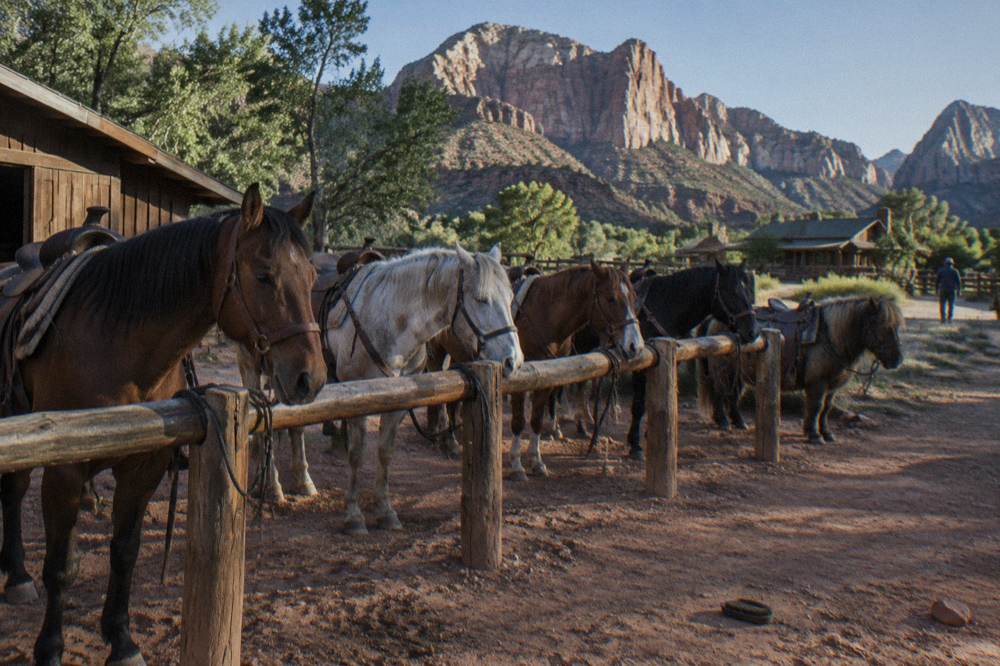
The age structure around Zion splits the family market in a useful way. Only the White Mountain tour among the East Zion Adventures rides states a minimum age, 8. The Checkerboard and Kanab Cave Lakes listings give no minimum age. In-park, the concessioner splits its rides at 7 for the one-hour Virgin River route and 10 for the three-hour Sand Bench ride. Below all of that sits the Little Wrangler ride: 15 minutes, hand-led by a wrangler, a scenic loop around the cabins near Mt Carmel, from $32 per person, minimum age 3. Because a wrangler leads the horse on foot and the ride stays on flat ground, the listing carries no stated weight limit, though a child big enough for a full trail ride belongs on one instead.
For ages in between, parents should read minimum age and weight limit together, not separately. A tall 9-year-old who clears the age line on the East Zion White Mountain ride clears the 100 kg line easily in practice, and the check-in question is a formality. The age limits exist for attention span, stirrup fit, and the ability to follow a wrangler's instructions on a live animal, which is a different question from weight, and one the ride picker on our homepage comparison walks through family by family.
How Should You Prepare If You Are Near The Limit?
Book the listing whose limit clears you with room to spare, weigh yourself the morning of the ride with the clothes and boots you will wear, and message the operator before paying if the margin feels thin. Those three steps prevent nearly every over-limit refusal, because the check-in question is easy to answer well when the answer is genuinely inside the number.
Start with the booking decision, because it is the only step you fully control. A rider just over 100 kg should not book a 100 kg listing hoping for rounding; White Mountain, Checkerboard and the Kanab canyon ride each carry that cap. The Rove and Ramble listings state no rider weight limit, and their guided Juniper Ridge hour is the lowest-priced one-hour ride in the comparison at from $68 per person. Riders who want the slot canyon walk on the East Zion White Mountain ride, or the canyon scenery of the Kanab Cave Lakes ride, rated 4.9 across 122 reviews, need to be under 100 kg for those listings specifically.
Next, weigh yourself in riding clothes. Boots, jeans, and a phone in a pocket add real pounds, and wranglers count what sits in the saddle, not what the bathroom scale said last month. If the morning-of number is within a few pounds of the limit, contact the operator through the booking page before you drive out. Operators move riders between horses and sometimes between departures, and a call ahead turns a corral-side refusal into a manageable change of plan.
Finally, pack for the check-in itself. The rides here meet at ranches and trailheads, not at staffed visitor desks: the East Zion rides meet near the pickleball courts lot on the east side with a short walk to the corrals, and the Rove and Ramble rides meet at the ranch near Mt Carmel. Arrive early enough to answer the check-in questions, get a helmet if you want one, and be assigned a horse without rushing. Helmets are recommended for all riders on guided tours in the region, and closed-toe shoes are the standard footwear expectation.
Riders carrying a few extra pounds often land best on the Juniper Ridge ride from Rove & Ramble: it is a one-hour, gentle loop around a bison preserve with an experienced guide, built for comfort rather than athletic riding. The listing makes clear that bison sightings are a chance, never a guarantee, and the same honest framing applies to the ride itself, it is a walk, not a workout. For the fullest version of that comparison, the guide to what to wear riding in Zion covers gear, and the guide to weight limits on Zion rides expands the numbers above.
The bare question in the title is a closing FAQ entry for a reason: it is the exact phrase riders type before booking, and the answers around it, on refunds, on kids, on which limit applies where, are the follow-ups that actually decide the booking. These are the six questions this article gets asked most, answered in one place.
Common Questions About Weight Checks At Horseback Riding
Do they weigh you before horseback riding?
Usually not on a scale. Operators near Zion check weight verbally at check-in, and a wrangler may make a visual assessment or ask a confirming question. The listed limit, 220 pounds in-park, 100 kg on the outside-park rides that state one, is enforced against that check.
What is the weight limit for horseback riding in Zion National Park?
The in-park concessioner, Canyon Trail Rides, states a 220 pound limit on both its one-hour Virgin River ride and its three-hour Sand Bench ride. Outside-park rides near Zion list 100 kg on the East Zion Adventures and Kanab rides.
Will I get a refund if I am over the limit at check-in?
Not automatically. The limit is a published booking condition, and an over-limit refusal is handled at the operator's discretion on site. Canyon Trail Rides publishes a 24-hour cancellation policy for refunds of the ride cost, but an on-site refusal is a different case; contact the operator before booking if you are near the line.
Is there really a 100 kg weight limit on some of these rides?
Yes. Many riders near 100 kg simply book a ride and never think about the scale again.
Do kids get weighed before riding?
Rarely as a separate step. Minimum ages screen several family rides, starting at 8 on the White Mountain tour and 7 on the in-park Canyon Trail Rides, with age 3 for the hand-led Little Wrangler ride, which lists an age but no weight limit. A child old enough for a standard trail ride is checked the same way adults are.
Do operators use scales anywhere near Zion?
None of the operators reviewed here publishes a scale weigh-in. The published practice is a stated limit enforced at check-in, with horse assignment by the wrangler based on the rider's stated weight, experience, and comfort level.