Zion Horseback Riding Weight Limits: Who Can Ride
Rider weight limits decide who can book before price or scenery ever come into it. Here is what every Zion-area operator actually states, what the 20% rule means, and what a 250, 270 or 300 lb rider can realistically ride.
Short answer
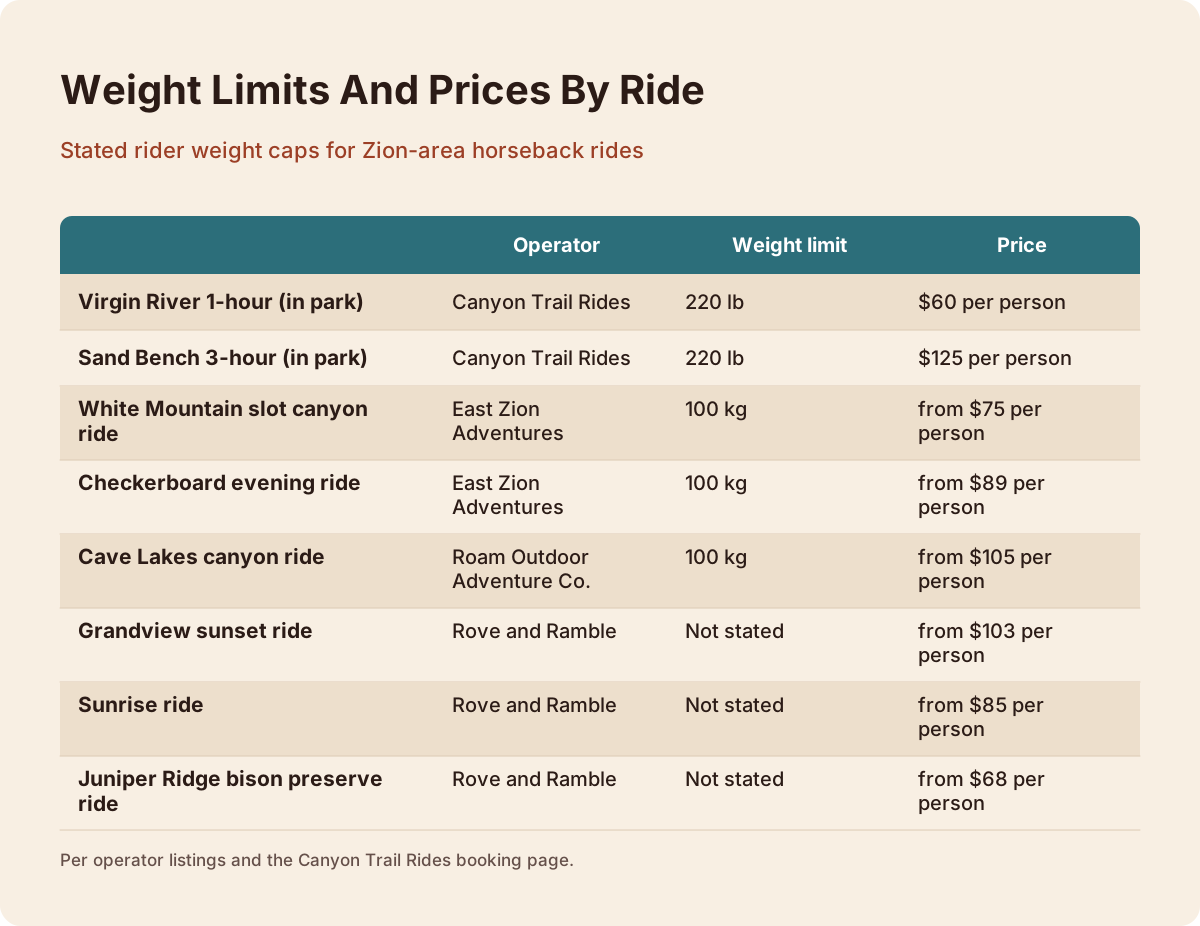
"Inside Zion National Park, Canyon Trail Rides states a 220 lb weight limit on both its rides. Outside the park, the rides compared here state a 100 kg weight limit at East Zion Adventures and Kanab, while the Rove and Ramble rides near Mt Carmel publish no weight limit, from $68 per person.
Rider weight is the one gate that decides a booking before scenery, price or time of day enter the picture. Inside Zion National Park, the National Park Service concessioner Canyon Trail Rides states a firm 220 lb limit on both of its guided rides, the one hour Virgin River trip at $60 per person and the three hour Sand Bench trip at $125 per person, according to the operator's own page. Outside the park the picture widens: the East Zion Adventures rides state 100 kg, the Kanab Cave Lakes canyon ride states the same, and the Rove and Ramble rides near Mt Carmel publish no age or weight limit at all, so check the listing before booking on Zion Horseback Tours. This guide lays out every stated limit, explains the 20% rule that sits behind most of them, and gives heavier riders an honest read on the options rather than a sales pitch.
What Are The Weight Limits For Horseback Riding Near Zion?
Limits vary by operator: 220 lb on rides inside the park, 100 kg on several East Zion and Kanab tours. Canyon Trail Rides, the in-park concessioner, sets 220 lb on both its rides. The East Zion Adventures and Kanab Cave Lakes listings state 100 kg. The Rove and Ramble rides near Mt Carmel state no weight limit. The Little Wrangler kids' ride states no limit on its listing because a wrangler leads each horse by hand.
The pattern is consistent across the region, and it is not arbitrary. Commercial stables work with the horses they have, on the terrain they ride, and they set the number that keeps both horse and rider safe on that ground. The in-park concessioner publishes its limit on its own page, and the NPS horseback riding page confirms the rides themselves run along the Virgin River and the Sand Bench Trail. The operator's booking page is the authority on the current figure.
Outside the park, the limits come from each live listing. East Zion Adventures runs its White Mountain slot canyon ride and its Checkerboard evening ride, both with a 100 kg limit; the minimum age of 8 applies to the White Mountain tour only, and Checkerboard states no minimum age. Roam Outdoor Adventure Co. runs the Kanab Cave Lakes canyon ride with the same 100 kg limit. Rove and Ramble, which operates from a ranch near Mt Carmel, publishes no rider weight limit on the listings for its Grandview sunset ride, sunrise ride or Juniper Ridge ride, while the Little Wrangler kids' ride sets a minimum age of 3.
| Ride | Operator | Weight limit stated | Price |
|---|---|---|---|
| Virgin River 1-hour (in park) | Canyon Trail Rides | 220 lb | $60 per person |
| Sand Bench 3-hour (in park) | Canyon Trail Rides | 220 lb | $125 per person |
| White Mountain slot canyon ride | East Zion Adventures | 100 kg | from $75 per person |
| Checkerboard evening ride | East Zion Adventures | 100 kg | from $89 per person |
| Cave Lakes canyon ride | Roam Outdoor Adventure Co. | 100 kg | from $105 per person |
| Grandview sunset ride | Rove and Ramble | Not stated | from $103 per person |
| Sunrise ride | Rove and Ramble | Not stated | from $85 per person |
| Juniper Ridge bison preserve ride | Rove and Ramble | Not stated | from $68 per person |
| Little Wrangler kids' ride | Rove and Ramble | none stated on the listing | from $32 per person |
A note on the Little Wrangler line: the absence of a stated limit is not an invitation to test one. It is a 15-minute hand-led loop for children aged 3 and up, priced from $32, and a wrangler walks beside the horse the whole way. The listing simply does not frame weight as a factor for that ride. For every other ride above, the stated limit is a booking condition the operator enforces.
Why does the limit cluster so tightly around the same figure? Two reasons. First, a commercial string must carry a range of riders all day, every day, and owners budget the horses' workload accordingly. Second, the terrain here is not flat. Rides climb sand benches, cross rocky washes and descend into slot canyons, and a horse balancing a load on a grade carries more effective stress than the same horse on a level road.
Can A 300 Lb Person Ride A Horse?
On the guided rides around Zion, the stated limits are 220 lb in the park, 100 kg at East Zion Adventures and 100 kg at Kanab; the other listings on this page publish no rider weight figure. In general riding, a 300 lb person can ride a horse when a suitably large draft-cross mount and a saddle built for the weight are available, but no ride compared here states a limit that covers it.
That is the honest answer, and it is better to read it here than at a corral. The stables near Zion do not publish a heavier option, and arriving over the limit usually means being turned away on the day, which is a lost ride and a lost fee depending on the cancellation terms. The in-park concessioner's cancellation policy refunds the ride cost only when cancelled 24 hours ahead, with online booking fees non-refundable, as its page states.
The general riding world is more flexible than the commercial one. Common riding guidance holds that a horse can comfortably carry around 20% of its own body weight, rider plus tack, and larger draft-cross horses can carry heavier riders within that guideline. Some ranches elsewhere in the country keep larger string horses and heavier saddles specifically for this. None of the Zion-area listings compared on this site states such an option. If a 300 lb limit question is the deciding factor for your trip, the productive move is to email operators directly before booking and ask, because a phone conversation can sometimes find a mount that a listing's blanket policy does not advertise.
With no rider weight limit stated on their listings, the Rove and Ramble rides near Mt Carmel are the widest open door on this page. The Juniper Ridge bison preserve ride, from $68 per person, is the least expensive hour-long ride available, and the Grandview sunset ride, from $103, puts the golden hour to work with panoramic views toward Zion, Bryce Canyon and the Grand Staircase. Ratings and review details appear on each listing page.
Weight interacts with fit beyond the number, too. A rider at the top of a stated range with a tall frame may fit a saddle differently than a shorter rider at the same weight. Operators handle this at check-in, which is one reason the booking page asks for rider details, and one reason to be accurate when you enter them. Understating weight to pass a form is the fastest way to a refused mount in the parking lot.
For planning beyond this page, the broader ride-by-ride comparison in the how to choose a Zion horseback ride guide covers how these listings differ on everything except the scale.
Can A 270 Lb Person Ride A Horse?
A rider over 100 kg is above the cap on the White Mountain, Checkerboard and Kanab rides, and over the 220 lb limit on the in-park Canyon Trail Rides; the Rove and Ramble listings state no weight limit. Of the rides compared here, the Grandview sunset, sunrise and Juniper Ridge rides are the listings that publish no weight limit, so confirm with the operator before booking.
That margin is thin, and it is worth treating carefully. Limits are sometimes given in kilograms and sometimes in pounds, and a limit stated in metric sits only a short distance above a 270 lb rider. A 270 lb rider booking a Rove and Ramble ride is inside the stated policy but close enough to its edge that adding winter layers, a daypack or boot weight on the corral scale could matter. The practical advice: book the Mt Carmel rides, weigh yourself with the clothes and boots you will ride in, and if the total lands anywhere near the stated ceiling, call the operator before paying.
The same rider is over the in-park limit by 50 lb, and no amount of phrasing at the corral changes that. Canyon Trail Rides states 220 lb on both its rides, per the operator's own page, and the booking page is the authority on any change. The page also states the check-in point, the Emerald Pool trailhead parking lot across from Zion Lodge, and the 30-minute early arrival.
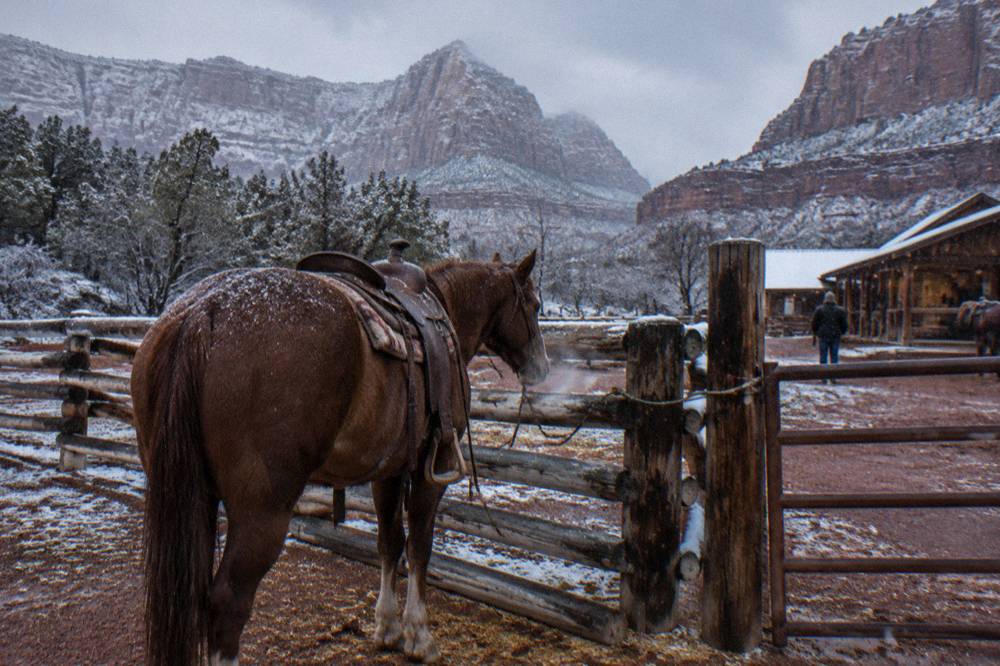
A 270 lb rider weighing options should also think about the ride itself, not just admission to it. A one-hour ride is a gentler introduction for any rider near a limit, because the load the horse carries is short. The Rove and Ramble rides are all about one hour long; the Juniper Ridge bison preserve ride, the sunrise ride and the Grandview sunset ride each run roughly an hour with a guide. The East Zion and Kanab listings, at 100 kg, are off the table at this weight, including the two East Zion Adventures rides and the 1.5-hour Kanab Cave Lakes canyon ride with its 4.9 rating across 122 reviews.
| Rider weight | In-park rides, 220 lb | East Zion and Kanab, 100 kg | Rove and Ramble, no stated limit |
|---|---|---|---|
| 200 lb | Fits | Fits | Fits |
| 220 lb | At the limit, ask the operator | Fits | Fits |
| 250 lb | Over | Over | Fits |
| 270 lb | Over | Over | Fits, close to the edge |
| 300 lb | Over | Over | Over |
The table above is a reading of the stated limits, not a promise. Borderline cases at any operator go to the operator, and the answer may depend on which horses are working that day.
Is 250 Lbs Too Heavy To Ride A Horse?
No, heavier riders can often still ride, though limits vary: the Rove and Ramble rides near Mt Carmel state no rider weight cap, so check the live listing. It is over the 220 lb in-park limit and the 100 kg limit on the East Zion Adventures and Kanab listings, so around Zion the answer depends entirely on which stable you book.
The 20% guideline, covered in full in the next section, explains why 250 lbs sits in a gray zone rather than a hard one. A horse in a commercial string may weigh 1,000 lb or well above it, and the same guideline that fits a lighter rider on a lighter horse fits a heavier rider comfortably on a heavier one. A 250 lb rider needs a bigger-bodied horse to stay within the guideline, and stables that own such horses state limits that reflect them.
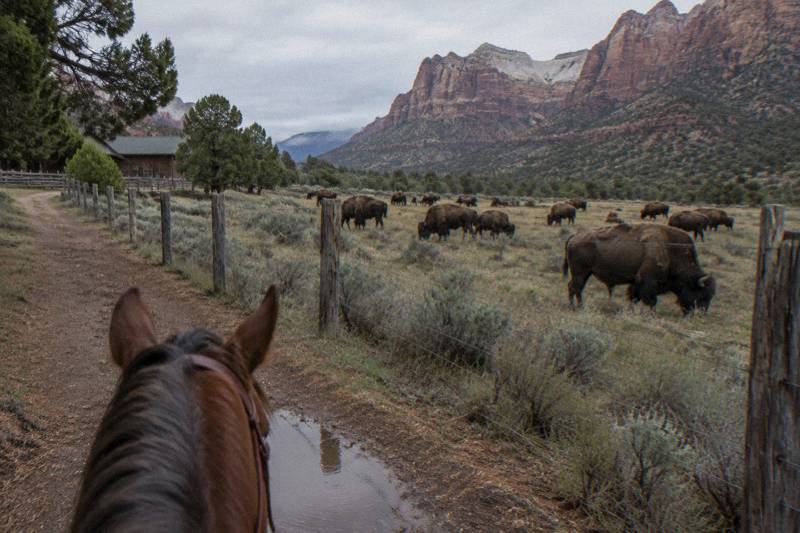
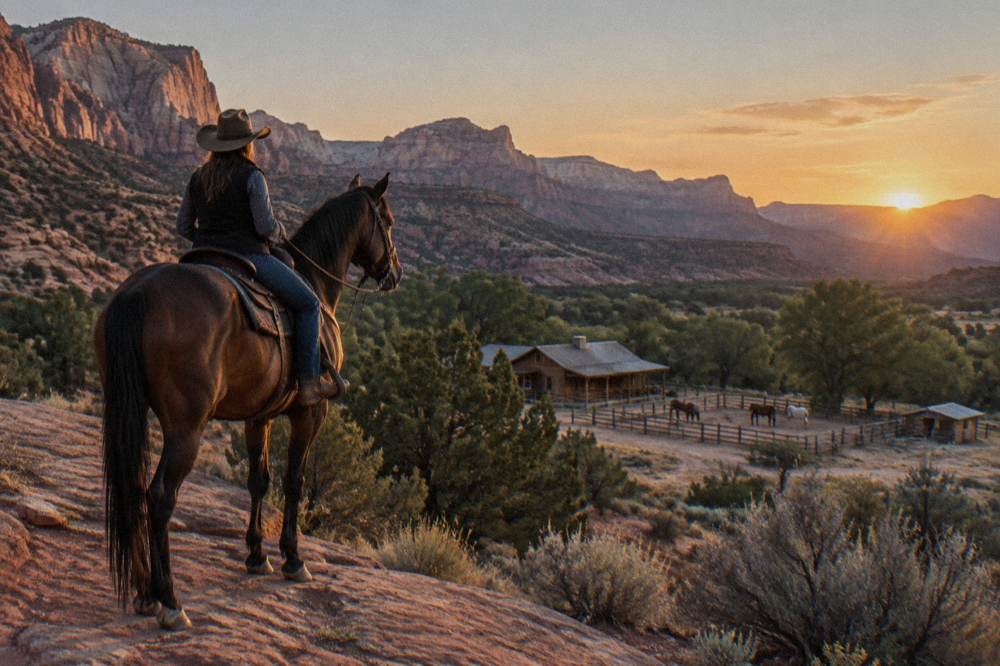
That is precisely what the Rove and Ramble listings do. The operator's rides run from a working ranch near Mt Carmel, with access to panoramic country toward Zion National Park, the Grand Staircase and distant Bryce Canyon. The sunrise ride, from $85 per person, is built around the early start and the wide views of the Grand Staircase and Zion's East Gate. The Grandview sunset ride, from $103, is the same country at the other end of the day, with a chance, never a guarantee, of seeing bison.
For a 250 lb rider who wants the in-park experience specifically, the honest position is that the concessioner's stated 220 lb limit does not bend. The rides this site compares are all outside the park boundary, and the in-park rides are booked directly with the concessioner. What the outside-park listings give up in canyon-floor scenery they partly return in openness: no shuttle timing, no scenic-drive access questions, and parking at the ranch where you mount up. The logistics comparison in inside versus outside the park riding lays out that trade in full.
What Is The 20% Rule In Horse Riding?
The 20% rule says a horse should carry no more than about 20% of its own body weight, counting rider plus tack, for the work to stay comfortable and safe. It is a widely used general horse-welfare guideline from common riding guidance, not an NPS regulation and not a stated policy of any Zion-area operator, and research on it is indicative rather than settled law.
The arithmetic works like this. Take the horse's weight, take a fifth of it, subtract the saddle and pad, and what remains is the comfortable rider weight for that animal. The heavier the horse, the more rider it carries within the same guideline, which is why big-bodied draft crosses are the answer for heavier riders and why a stable that owns them can state a higher limit than one that does not.
| Horse weight | 20% total load | Minus tack, about 35 lb | Comfortable rider weight |
|---|---|---|---|
| 1,000 lb | 200 lb | 165 lb | about 165 lb |
| 1,400 lb | 280 lb | 245 lb | about 245 lb |
| 1,600 lb | 320 lb | 285 lb | about 285 lb |
Three caveats keep the rule honest. First, it is a guideline, not a cliff edge: horses above 20% do not immediately fail, and horses below it can still be mismatched to the work. Second, terrain and duration change the math. A one-hour walk on flat sand asks far less of a horse than a three-hour climb with a loaded rider, which is why the same operator can set one limit for a gentle loop and another for canyon terrain. Third, the rider matters beyond the scale: a balanced rider who moves with the horse is easier to carry than a stiff or unbalanced one at the same weight. The physical demands of horseback riding cut both ways, for horse and rider alike.
Where the NPS does state rules, they concern which animals may be used and where, not rider weight. Horses, mules and burros are the only stock animals allowed in Zion, parties are capped at six animals, and stock are prohibited during spring thaws, unusually wet periods, or when use would cause trail damage, per the wilderness regulations page. Those rules govern the horse's welfare on public land at a policy level; the 20% rule governs it at the level of an individual ride, which is why commercial operators translate it into a number on a listing.
At What Weight Should You Not Ride A Horse?
There is no universal weight at which a person should not ride, because it depends on the horse, the tack and the terrain. Around Zion, the practical ceilings are the stated limits: 220 lb for the in-park rides, 100 kg for East Zion Adventures and Kanab. A rider over all of those should not book these rides, and should look for a stable that states a higher limit or offers larger mounts.
The ethical framing is worth stating plainly, because it is the reason limits exist. A horse carrying too much weight over rough ground risks back soreness, lameness and long-term damage, and no view is worth that. Operators who state a limit and enforce it are protecting their animals, and a rider who respects it is part of that. The decision to ride is not only about whether a booking form accepts a number.
For riders who fall between the cracks, a few honest routes exist. Ask operators directly about larger mounts before writing off the whole activity; some ranches elsewhere in Utah and the wider West keep draft crosses and state higher limits, and a phone call or email finds them. Consider a shorter ride if one is available, since load duration matters. And if riding is not available at your weight on this trip, Zion has plenty of other ways into the landscape, and the park's own horseback riding page remains the reference for what is permitted inside the boundary.
One related question that trips up families: do children face weight limits? On the rides compared here, minimum ages are the stated gate for kids, 3 on the Little Wrangler hand-led ride and 8 on the White Mountain tour, the only listings that publish one, and adult weight limits apply only where a listing states them. The details sit in the Zion riding age limits and kids guide.
How Do Operators Handle Weighing Riders?
The stated weight limit is the enforceable rule. The in-park concessioner states 220 lb as a firm condition of riding, and outside-park listings state their limits the same way. If you're unsure what those weight questions actually look like when you arrive at the stable, our walkthrough of pre-ride weight checks explains what operators ask and what happens if a limit comes into play.
The mechanics matter because they explain where the awkward moments happen. A listing that states a 100 kg limit expects accurate self-reporting at booking. At the corral, a wrangler sizing a rider to a horse can and does decline a mount that looks over the limit, and that decision is final on the day. The separate question of whether riders get weighed, how it feels and what to expect is covered in full in do they weigh you before horseback riding, which pairs with this page.
The practical advice is unglamorous. Weigh yourself at home with riding clothes and boots on. Book the listing whose stated limit clears that number with room to spare. Enter the accurate figure wherever the booking asks. If you are close to any stated limit, email the operator before paying and ask how they handle borderline cases. Every operator prefers that conversation to a refusal at the rail.
For families, one ride in this comparison removes the question entirely. The Little Wrangler ride near Mt Carmel is a 15-minute hand-led loop for children from age 3, priced from $32, with a wrangler holding the horse the entire time and no weight limit stated on the listing. It exists precisely for riders too young or too small for a trail string, and it is the answer to "what can the little one do while the rest of us ride."
How Big Is Too Big To Ride A Horse?
"Too big" is a ratio, not a number: a rider is too big for a given horse when rider plus tack exceeds roughly 20% of that horse's weight, or when the available saddle does not fit the rider safely. Around Zion, only a few listings publish a rider weight limit, and the rides near Mt Carmel post none at all; heavier riders should ask each operator directly, since figures vary and some venues simply are not the right fit.
Size is more than weight, and honest coverage has to say so. Height and inseam affect whether stirrups adjust to a safe length and whether the saddle seat fits; a very tall rider at a moderate weight can fit one horse poorly and another well. Balance and fitness matter, and the preparation angle is covered in the beginners guide to Zion horseback riding. The scale is the gate the industry can state in one number, so it is the number listings publish.
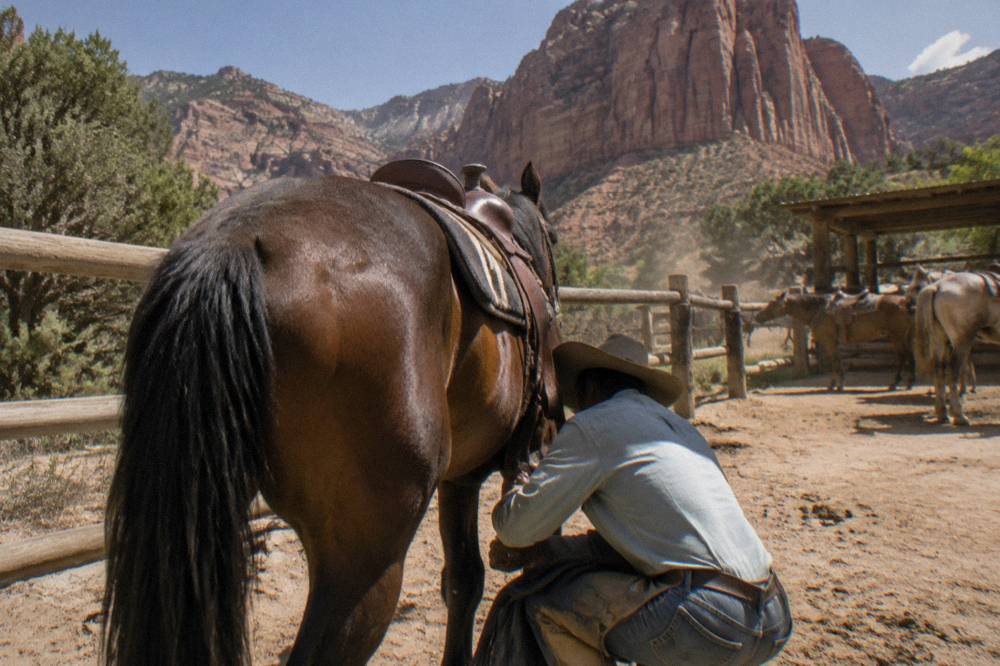
For riders who fit the stated limits, the choice among the rides compared here comes down to experience and budget rather than the scale. The East Zion White Mountain slot canyon ride, from $75 per person and rated 4.8 across 506 reviews, is the most reviewed ride in this comparison and pairs the hour on horseback with a short guided hike into a slot canyon, at the 100 kg limit. The Checkerboard evening ride from the same operator, from $89 and rated 4.7 across 46 reviews, runs about 1.5 hours at the same limit. Riders under the 220 lb ceiling have the full menu.
| Ride | Best for | Stated limit | Length |
|---|---|---|---|
| Juniper Ridge bison preserve ride | Value and families, bison preserve visit | Not stated | about 1 hour |
| Grandview sunset ride | Golden-hour views, possible bison | Not stated | about 1 hour |
| Sunrise ride | Beating summer heat, early light | Not stated | about 1 hour |
| White Mountain slot canyon ride | Most reviewed, canyon walk | 100 kg | about 1 hour |
| Checkerboard evening ride | Longest East Zion option | 100 kg | about 1.5 hours |
| Cave Lakes canyon ride | Highest rated | 100 kg | about 1.5 hours |
Riders over the 100 kg ceiling stated by several of these listings deserve a straight answer: the in-park Canyon Trail Rides cap is 220 lb, and anything heavier needs a check with the operator before booking. The regional options that sometimes accommodate heavier riders, larger ranch horses, private operators with draft crosses, sit outside this comparison and are found by direct inquiry. What this site can state is every real limit on every real listing, which is the table at the top of this page.
Common Questions About Zion Horseback Riding Weight Limits
What is the weight limit for Zion horseback rides?
Every operator here sets its own. In-park Canyon Trail Rides cap riders at 220 lb, East Zion Adventures and the Kanab operator state 100 kg, and the Rove and Ramble listings do not publish a weight figure. In general riding, a 300 lb person can ride when a large draft-cross horse and suitable tack are available, which some ranches elsewhere offer by direct arrangement.
What is the 20% rule in horse riding?
It is a general horse-welfare guideline that a horse should carry no more than about 20% of its own body weight, rider plus tack combined. It comes from common riding guidance, not from the NPS or from any operator's policy, and it is indicative rather than a strict threshold.
Is 250lbs too heavy to ride a horse?
No, but around Zion it limits the menu. The in-park rides cap riders at 220 lbs, and the East Zion Adventures and Kanab rides set a 100 kg limit. The Rove and Ramble listings state no weight restriction, so heavier riders should confirm directly with the operator before booking.
At what weight should you not ride a horse?
There is no single universal weight. The practical ceilings here are the stated operator limits, 220 lb in the park and 100 kg at East Zion and Kanab, and riders above them should check each listing before booking, since not every ride on this page publishes a limit.
How big is too big to ride a horse?
Too big is a ratio, not a number: rider plus tack exceeding roughly 20% of the horse's weight, or a saddle that cannot safely fit the rider. Height, inseam and balance affect fit too, which is why wranglers size riders to mounts at check-in.
Can a horse carry a 300lb person?
A large, sound, heavy-bodied horse can carry a 300 lb rider plus tack within the 20% guideline, but no commercial ride in the Zion area states a limit that accommodates it. Riders at that weight should contact ranches directly about larger mounts before planning a ride.